How I Can Help
You understand the pattern. So why does it still take over when it matters?
You may already know a lot about yourself. Once a difficult moment has passed, you can often see where your reaction came from.
But knowing the pattern afterward doesn’t always help when you’re right in the middle of it. That’s when it can show up in your relationships, important decisions, or the way you relate to yourself, especially when something meaningful feels at stake.
Where Familiar Patterns May Be Showing Up
In Your Relationships
A difficult conversation, a shift in someone’s tone, or a moment of distance can quickly take on a life of its own. You may start wondering what the other person really meant, bracing for what might happen next, pulling away, getting defensive, or feeling pressure to fix things right away.
If relationships are where these patterns show up most strongly, learn more about relationship coaching.
In Important Decisions and Life Changes
You may keep going over your options, trying to anticipate every consequence or find the choice that feels completely certain. Instead of getting clearer, you end up more tangled in second-guessing. The harder you try to think your way through it, the harder it can be to know what you actually want.
In The Way You Relate to Yourself
Your mind may keep returning to what you should’ve done differently, what you still haven’t figured out, or what your reactions seem to say about you. Even when you can see the self-judgment, it may still feel less like a thought and more like the truth.
These may look like different problems, but they often follow a similar pattern.
Why Understanding Isn’t Always Enough
Understanding a pattern afterward isn’t the same as noticing it while it’s shaping what you see and how you respond.
The whole process can happen fast.
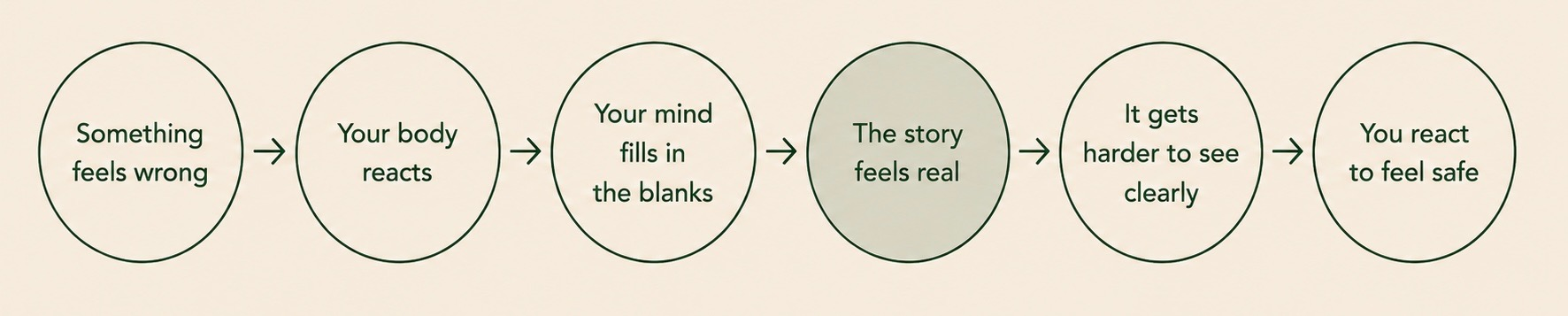
When something feels wrong, your body may react before you’ve had time to make sense of what’s happening. The moment gets charged, and your mind starts trying to explain why.
That explanation can come together in seconds. You may decide that someone is upset with you, that something is going badly, or that you need to do something right away.
Once that story starts to feel true, it can be hard to take in anything else. You may pull away, press for an answer, get defensive, overexplain, or try to get the situation back under control.
How We Work Together
We slow down specific moments together. We notice what happened, what you felt in your body, what you found yourself wanting to do, what your mind made it mean, and when that meaning began to feel certain. Sometimes we simply make room for the experience before trying to explain it.
We’re not trying to prove that your thoughts are wrong or talk you out of what you feel. Some situations really are painful, difficult, or uncertain.
The aim is to help you recognize the pattern while it’s happening, so more perspective, steadiness, and choice can become available.
What Begins to Change
As familiar patterns become easier to recognize, a difficult interaction may have less hold on the rest of your day. And when you do get pulled in, you can begin to find your way back without turning the reaction into another reason to judge yourself.
That creates more room to pause, take in more of what’s actually happening, and respond in a way that reflects what matters to you.
The goal isn’t to control your mind or stay calm all the time. It’s for familiar thoughts and reactions to have less unquestioned authority over how you see yourself, other people, and the choices in front of you.
If you’re wondering whether this kind of work might fit what you’re looking for, you can read more about whether we may be a good fit.
Start with a short conversation
A free 20-minute call is a simple way to talk about what is happening, ask questions, and see whether working together feels like a good fit.